
Manchester City Directory Holdings
In Hartford County, Manchester's directory story is a shelf with several custodians, not one continuous digital run. Manchester Public Library identifies city directories beginning with 1891 and says many years are available in the reference case. The Manchester History Center keeps local genealogy and history material, maps, yearbooks, and vintage business directories. The Manchester Historical Society provides named reprints and scans for several important years.
| Collection | Years or span | Where held | Access and value |
|---|---|---|---|
| Manchester Public Library directory shelf | Beginning 1891; exact run varies | Reference and local-history case | Ask staff for the year and section |
| Bower's Manchester directory | 1896 identified | History Center or local-history holdings | Early name and address bridge; verify physical copy |
| Historical Society directory runs | 1917, 1922, 1927 | MHS reprint collection | Residents, businesses, and advertising context |
| Price & Lee directory | 1934, 1943, 1946 | MHS scan and History Center | 1934 is digitized; later access should be confirmed |
| Later Price & Lee holdings | 1953-54 and other years | History Center research library | Useful for household continuity where a volume survives |
The gaps matter. Official descriptions do not promise every intervening year, a complete reverse run, or a stable online scan for each volume. A missing year can reflect a collection gap, a publisher change, a damaged copy, or access that remains on the shelf. Record the exact publisher, year, page, and section when a hit matters.
Manchester Directories Begin in 1891
The 1891 starting point makes Manchester unusually workable for an address-through-time project. Begin with the Manchester Public Library genealogy page and ask the reference desk whether a year is alphabetical, business, telephone, or address-indexed. The library's reference number is 860-645-0821 and its email is reference@manchesterct.gov. A library card may be needed for licensed databases, but the rule for a bound volume is a separate question.
The library also points to the Manchester Newspaper Database, local newspapers, Ancestry Library Edition, Cheney oral histories, and a Civil War veteran burial book. Those sources can supply the surname or date needed to open a directory volume. They can also explain a disappearance from the alphabetic section without turning an old entry into a claim about a current person.
The reference and adult-services page notes a Hartford Courant ProQuest gap from 1923 through 1991, with other years available through ResearchIT CT routes. That negative fact is practical: a missing newspaper result should send the search to the local database, library staff, or a physical holding.
The 1917 to 1946 Manchester Runs
The Historical Society reprint collection gives the historical page a firmer set of named landmarks: 1917, 1922, 1927, 1934, and 1946. The 1922 volume is identified as 362 pages, the 1927 volume as 464 pages, and the 1934 Price & Lee volume as 418 pages. The 1946 listing identifies a 716-page volume. Page counts are collection facts, not a promise that every page has clean OCR.
The reprint collection is available through the Manchester Historical Society directory page. It places the runs and publishers in view before a researcher travels. A useful log names the volume, page, section, spelling, address, and scan quality. If a surname is absent, check the business and classified portions, initials, married names, and neighboring entries.
The digitized collection is particularly valuable because it gives a direct comparison between a scanned local book and the physical reference case. It does not remove the need for the library or History Center. The local collection list identifies later Price & Lee directories, including 1943 and 1953-54, that should be confirmed with the curator.
- 1891: Manchester Public Library's identified starting point for local directory holdings.
- 1896: Bower's Manchester directory, an early name-and-address bridge to verify in the local collection.
- 1917-1927: Historical Society reprints that provide successive resident, business, and advertising context.
- 1934: Price & Lee volume with a digitized scan and a useful test case for page-level reading.
- 1943, 1946, and 1953-54: Later Price & Lee landmarks that should be confirmed with the History Center before relying on a specific page.
The Historical Society collection screen shows where the named Manchester city directory runs live online.
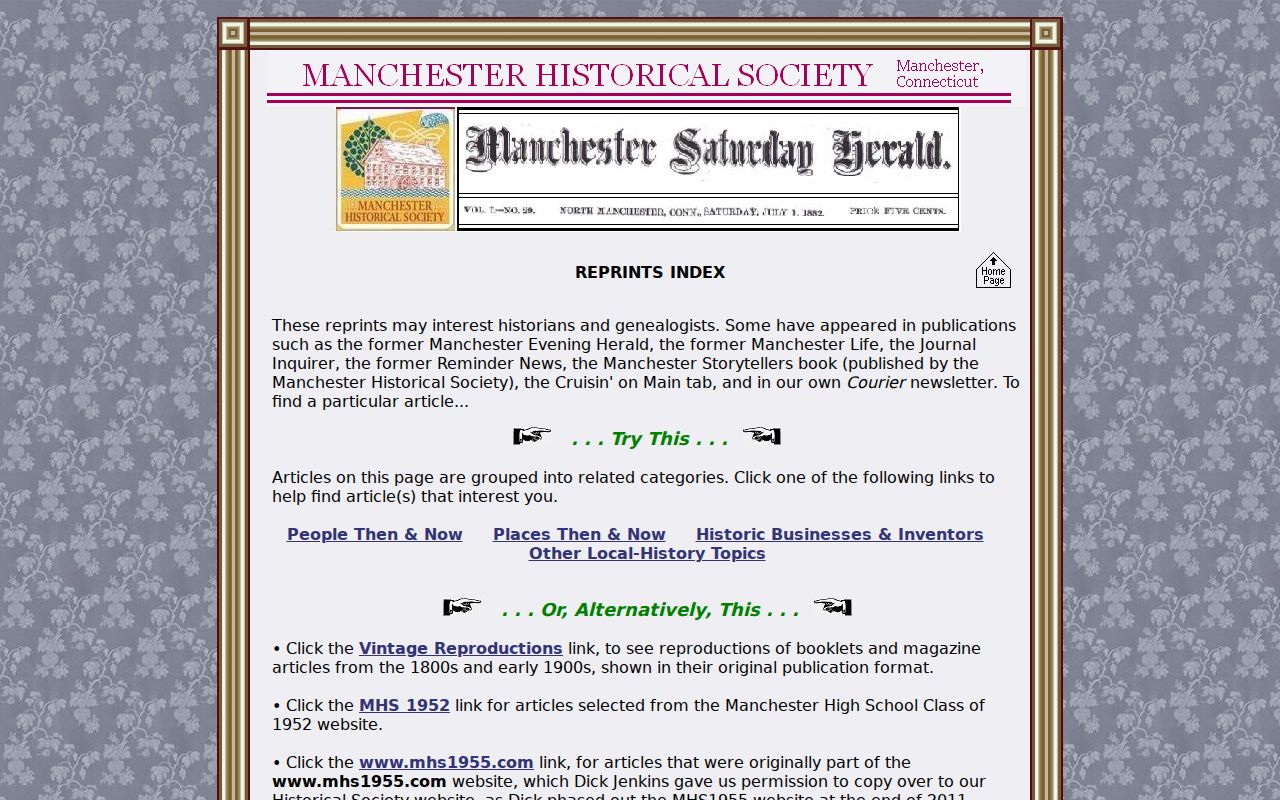
The image is a collection-level source, so use it to choose a year and then inspect the actual page. Do not assume that a collection landing page supplies a complete address index or a machine-readable name list.
Where Manchester City Directories Are Held
The Manchester History Center at 175 Pine Street is open Wednesday through Friday from 10:00 a.m. to 2:00 p.m.; its published phone is 860-647-9983. Its genealogy and history library includes school yearbooks, vintage business directories, maps, local books, and later research holdings. Ask a curator whether the needed volume is in the reading room, a reprint list, or an offsite collection.
The History Center's holdings complement, rather than replace, the library reference case. The Connecticut State Library genealogy guide adds census, probate, church records, town documents, newspapers, naturalization, military material, and archives routes. The State Library warns that some offsite collections are returning in stages during 2026, so check availability before traveling.
The Manchester History Center holdings page is the source for the local address, hours, yearbooks, directories, maps, and genealogy library.

The captured History Center page helps place a city directory visit with the local collection. Ask before travel whether a particular year is on site or needs staff retrieval.
Make Sense of a Manchester Directory Entry
The 1934 Price & Lee scan is the strongest local sample because it is an actual Manchester volume. A careful reading records the name as printed, any middle initial or spouse notation, the street address, the section heading, and the page number. Occupation, business affiliation, widow notation, telephone information, and abbreviations may appear, but the research does not establish that every publisher or year uses every field.
| Name | Printed surname and given name or initial, including cross-references when shown. |
|---|---|
| Household notation | Spouse, widow, or other status shorthand when the volume supplies it. |
| Address | House number and street, sometimes with a business location or local label. |
| Work or business | Occupation, firm, or classified entry where the publisher includes it. |
| Section and page | Alphabetical, business, classified, or address order, plus the scan or page locator. |
The 1934 Price & Lee directory scan is the source to open when a page-level entry is needed. The unattended text extraction did not verify one stable named row, so describe the actual selected page rather than promising an OCR result.
Manchester Criss-Cross Terms in Directory Volumes
Historical directory language can hide the search route. A volume may use an address order, a street section, a householder index, or a publisher's own abbreviation key. Manchester's public descriptions do not verify a complete separate reverse-directory run, so the safe method is to ask the reference desk for the year and inspect the front matter before searching a whole street.
- Criss-cross directory
- An address- or street-ordered section that can lead from a place to a name, when a volume includes one.
- Householder index
- A name or household index used to connect a person with a printed address.
- Abbreviation key
- The publisher's explanation of short forms for streets, occupations, relationships, or status marks.
- Index versus image
- An index points to a name or page; the scan or bound volume is where the printed context can be checked.
Photograph or note the abbreviation key first when the collection rules allow it. A short mark may change the meaning of a household entry, and a business section can look like a resident listing until the heading is read.
Trace Manchester Families Through Directory Years
A city directory is most useful as a sequence. Start with a known name or address, record the year and publisher, and then compare nearby volumes. Pair directory years with the public federal census years 1900, 1910, 1920, 1930, 1940, and 1950. The census shows household composition and enumeration geography; the directory may show a more exact street address, occupation, business, or yearly movement.
- Write the entry exactly as printed, including initials, spouse or widow notes, street abbreviation, number, occupation, and page.
- Check the next available Manchester city directory rather than assuming the person stayed at the same number.
- Compare the entry with a nearby census. Preserve the census geography because postal city and municipal boundaries are not the same thing.
- Use Vision and RecordHUB to separate an owner's title history from an occupant's directory history.
- Close a past-household trail with the newspaper database, cemetery, probate, or an eligible vital record, rather than guessing why a name vanished.
A missing entry can mean a move, death, a missed annual volume, a changed name, a different section, or an unlisted household. One gap is not a conclusion. The strongest family-history note states which sources were checked and what remains unknown.
Manchester Newspapers and Directory Card Files
The Manchester Newspaper Database is a local bridge between a directory entry and a family event. The library describes current and historical searching plus converted card-file content. It can lead to obituaries, marriages, anniversaries, school news, civic events, business changes, and notices that explain a move. A newspaper result is still a lead. Confirm a death or marriage with the municipal, state, cemetery, or Probate source that can legally answer the question.
The Hartford Courant route has the 1923-1991 ProQuest gap identified by the library. ResearchIT CT, the local newspaper database, physical holdings, and History Center material can cover the missing path. Search street variants, married and maiden names, initials, village names, and business names. A result may use South Manchester or North Manchester even when a later record uses a standardized town address.
Manchester Yearbooks and Directory Oral Histories
Manchester History Center yearbooks, including a cited 1958 Barnard Gateway example, can identify a former classmate, sibling, school, or neighborhood link that is absent from an assessment roll. The Cheney oral-history project includes more than sixty Manchester residents discussing family, education, recreation, the Depression, and the world wars. Those recordings and transcripts offer names and context, not a current address list.
Use a school year, local surname, street, or institution as the starting anchor. Then compare the historical clue with a directory, newspaper, cemetery, deed, or vital record. The oral-history material is especially useful for understanding industrial villages and family connections that a formal name index cannot show.
Manchester Directory, Census, and Deed Evidence
Three historical sources can point at the same household while proving different things. A directory is an annual publisher's snapshot of names and addresses. A census is a federal household enumeration with age, relationship, and occupation context. A deed is a recorded title instrument. Their dates can be close without being identical, and a mailing address or legal description may not match the printed street line.
| Source | Strongest evidence | What it cannot establish alone |
|---|---|---|
| Manchester city directory | Printed name, address, section, and sometimes occupation or status | Current presence or title |
| Federal census through 1950 | Household relationship, age, occupation, and enumeration geography | A current address or a legal parcel |
| Town Clerk land record | Recorded parties, date, document, legal description, and map | Every person who occupied the property |
Keeping those distinctions visible prevents a historical directory from being mistaken for a modern residents directory. It also makes a later correction easier because the source and date remain clear.
Manchester's Library Story and Directory Shelves
Manchester's local-history access has its own timeline. A Cheney worker reading room existed by 1840, employees petitioned for a library in 1850, and a public library association formed in 1871. A 1913 fire destroyed the South Manchester library quarters, and the North Manchester library moved to Robertson School in 1914. The documented fire is a library-history event, not evidence that Town Clerk land books or town vital records vanished.
That history helps explain why the strongest city directory research may split between the library reference case, the History Center, the Historical Society reprints, the State Library, and a local newspaper database. Ask the custodian which shelf or scan answers the exact year before assuming that a search-engine result is the full collection.
Use Manchester City Directory Access
Online reprints are useful for a first pass, but local staff can identify missing years, alternate publishers, physical page condition, and a reverse section that is not described on a public web page. The History Center at 175 Pine Street publishes Wednesday-Friday hours from 10:00 a.m. to 2:00 p.m. The library reference desk can route newspaper, database, oral-history, cemetery-book, and yearbook questions.
For deeper work, the Connecticut State Library genealogy guide links census, directories, vital records, probate, church records, archives, naturalization, and military routes. The guide warns that some offsite collections have changing availability in 2026. Call before a trip, save the collection name, and note whether copying, photography, or an appointment is allowed.