
Sources for Manchester Previous Residents
A house-history trail needs a source for each era. The current parcel can be identified in Vision and GIS, title instruments can be followed in RecordHUB, and historical occupants can be tested against directories, census schedules, newspapers, cemeteries, and Probate. The coverage table shows why no single previous residents list can answer every decade.
| Source | Years covered | Where held | What it shows |
|---|---|---|---|
| Manchester land records and maps | 1823-current | Town Clerk and RecordHUB | Deeds, liens, mortgages, releases, maps, legal descriptions |
| Vision assessment | Current; 2021 and prior 2016 revaluations | Vision and Assessor | Owner/account, mailing and situs context, traits, value history |
| Manchester directory shelf | Beginning 1891 | Public Library reference case | Names, addresses, business and household clues |
| Historical Society runs | 1917, 1922, 1927, 1934, 1946; later holdings | MHS and History Center | Named local volumes, residents, businesses, advertising |
| Federal census | 1790-1950 public schedule | NARA, State Library, library databases | Household relationship, age, occupation, enumeration context |
| Permits, newspaper, cemetery, probate | Varies by record and custodian | Town, library, History Center, Archives, PD-13 | Renovation dates, departures, death, burial, heirs, fiduciaries |
The table is a research map, not a claim that every year is digitized. The online permit cutoff, exact reverse-directory run, complete Sanborn coverage, and some archival availability remain gaps. Name the gap rather than filling it with a generic assumption.
Manchester Parcel Records Come First
Begin with the physical place, even when the goal is the previous residents of a Manchester house. Search Vision by address, owner, account, PID, or MBLU and save the current owner, mailing address, situs, parcel identifier, legal-description text, map or sketch link, and valuation history. Then open the Manchester GIS Parcel Viewer to compare the parcel shape, address point, roads, buildings, and adjacent lots.
The mailing address may be out of town or belong to a trust, corporation, bank, attorney, tax-bill recipient, or prior owner. The situs is the physical location. A deed may use a lot, map, block, or metes-and-bounds description rather than the current street number. Save both forms before searching the land index, because the legal description is often the bridge across an old address.
Follow Manchester Title Records Backward
Manchester's Town Clerk land-record page describes deeds, mortgages, releases, liens, maps, foreclosure registrations, and related filings from 1823 through current. RecordHUB is the online index and image route, though the live grantor and grantee search fields require an account. Original books remain the fallback for a paper image, an older scan, or a record that the online index does not expose.
- Use Vision to identify the current owner, PID or MBLU, situs, mailing address, and legal description.
- Search the current buyer as grantee in RecordHUB and find the purchase deed by date, legal description, book/page, or document number.
- Record every grantor, grantee, document type, date, map, easement, restriction, mortgage, release, lien, and related filing.
- Take the seller or grantor from that deed and search the name backward as the next grantee. Repeat the sequence through earlier transfers.
- When a record is too old or hard to read, call the Town Clerk at 860-647-3037, ask about original books or a rescan, and distinguish a filed copy from a certified copy.
- Grantor
- The party transferring an interest in the recorded instrument.
- Grantee
- The party receiving that interest.
- Chain of title
- The linked sequence of recorded transfers that connects a later owner to earlier parties.
- Legal description
- Lot, map, block, or boundary language that identifies the land when a street number is not enough.
When Manchester Land Scans Need Help
RecordHUB index and image access is described as free under portal terms, while printed portal images are $2 per page. A filed copy is generally $1 per page, with $2 added for certification. Recording a new instrument is separate from copying an old one. Effective July 1, 2025, the first land-record page is $70 and additional pages of the same document are $5, with special schedules for some nominee and map filings.
Paper requests can be mailed, placed in the drop box by the handicap entrance, or delivered in person with the volume, page, document number, or property description. Returned copies are mailed or held for pickup. The Town Clerk says complete paper land-record requests are ordinarily returned in three to four weeks, while a same-day recording or portal upload is a different event. Write the request narrowly and ask the office to confirm current fees.
PropertyCheck is a free alert option through the official Town Clerk and RecordHUB route. Use the official portal rather than paying a mailed service that copies government language.
Pair Manchester Directories with Census Years
Ownership tells who held title. A city directory and census can show who was associated with the address at a particular time. Manchester Public Library identifies directories beginning in 1891. Named Historical Society and Price & Lee runs include 1917, 1922, 1927, 1934, 1943, 1946, and 1953-54 holdings, though not every year is promised. Federal census schedules from 1790 through 1950 are public under the 72-year rule as of the research date.
- Write the directory name, year, publisher, page, street spelling, house number, occupation, spouse or status mark, and every household name.
- Compare the next available directory year and record any street, number, village, business, or surname change.
- Pair the directory with a nearby census year: 1900, 1910, 1920, 1930, 1940, or 1950.
- Use Vision and the deed chain to test ownership, because the person listed in a directory may not be the title party.
- Check the newspaper database, cemetery, probate, or eligible vital record when the household disappears.
The Manchester city directory collections page explains the historical volumes in full. Here the focus stays on using those volumes as time stamps in an address trail.
Manchester's State Library Trail
The Connecticut State Library genealogy guide connects census, town records, city directories, vital records, probate, church records, newspapers, naturalization, military material, and archives. The State Library also guides historical probate assignments and Hartford County Superior Court indexes from 1836 through 1951. Manchester was historically placed in the Hartford Probate District from May 1823 through June 21, 1850, so a modern PD-13 lookup should not be assumed to reach the nineteenth century.
The guide is a good fallback when the previous residents trail leaves the digital portal. The State Library warns that some offsite collections are returning in stages during 2026. Call or check availability before traveling, and ask whether a record is in a reading room, an archive series, a microfilm set, or an offsite request queue.
The captured genealogy guide is the source to open before choosing a nineteenth-century path.
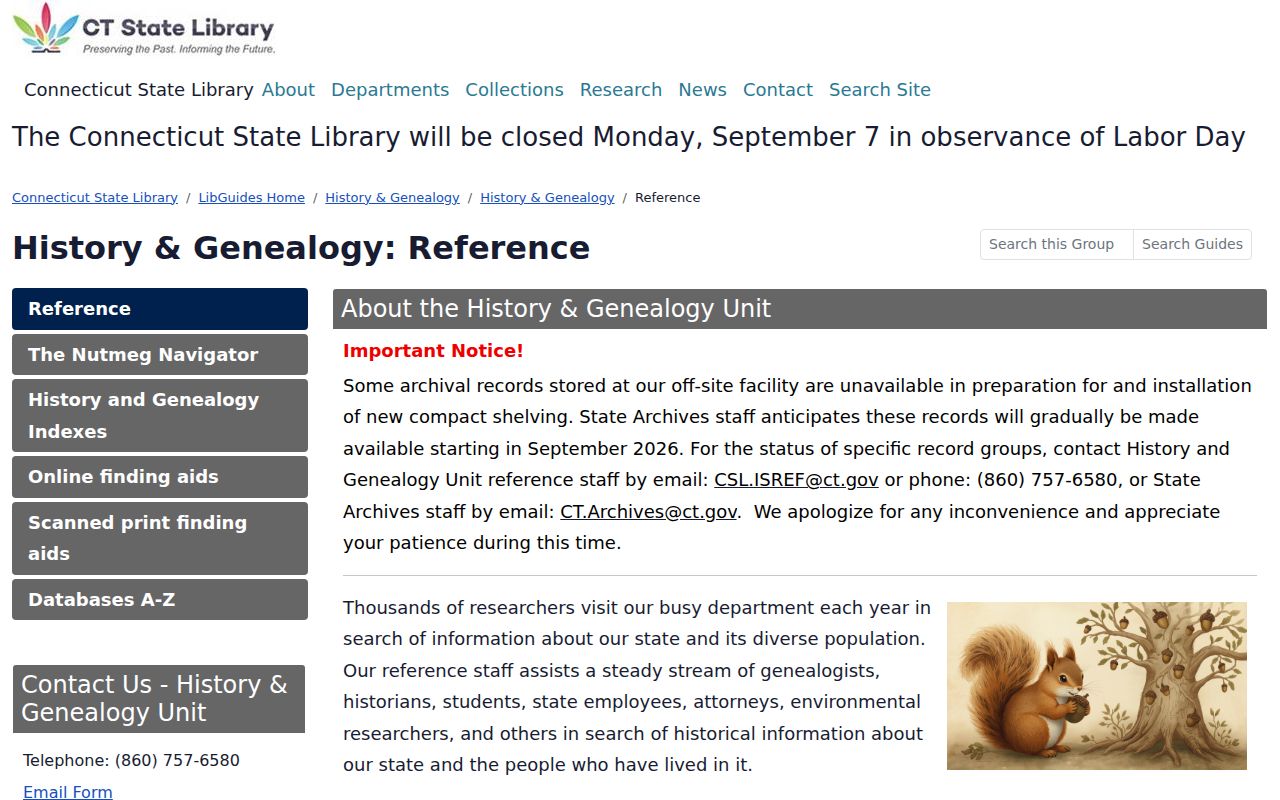
The image represents a statewide research route that complements Manchester's local shelf. It does not replace the Town Clerk, library, History Center, or Probate custodian.
Manchester Maps, Permits, and Villages
Manchester's industrial growth created address clues that can look odd in a modern search. The town was incorporated from East Hartford in 1823, shifted from farming to paper, wool, cotton, and silk production, and developed around the Cheney mills and railroad service. Historic names such as South Manchester, North Manchester, Parker, Highland Park, Hilliardville, Meekville, and Taylorville may appear in a directory or newspaper.
GIS layers and the Building Division CSS portal can date a physical change. The permit search accepts Plan, Permit, or All and recognizes forms such as `MIDDLE TPKE W/E` and `E/W CENTER ST`. It may show a work type, applicant, contractor, inspection, certificate, or attachment. It does not prove title, presence, or the date a household moved. No official chronology of every Manchester renumbering or renaming was located, so retain both old and standardized forms in the research log.
Close Manchester Previous-Resident Trails
When a directory ends at a death, marriage, or family change, use the correct certificate route. Manchester local vital records begin in 1823. Birth and fetal-death records under 100 years are restricted under Conn. Gen. Stat. §7-51. Birth records older than 100 years are open, while adult marriage and death records are generally obtainable with Social Security-number protections under §§7-51 and 7-51a.
The Connecticut vital-record application hub lists the state and local forms. Manchester's marriage form asks for both spouses' names before marriage, the event date, requester identity and relationship, copies, ID, payment, and return instructions. A death request asks for the decedent, date, requester, relationship, copies, ID, and whether protected Social Security information is sought. A form is an access route, not a public name index.
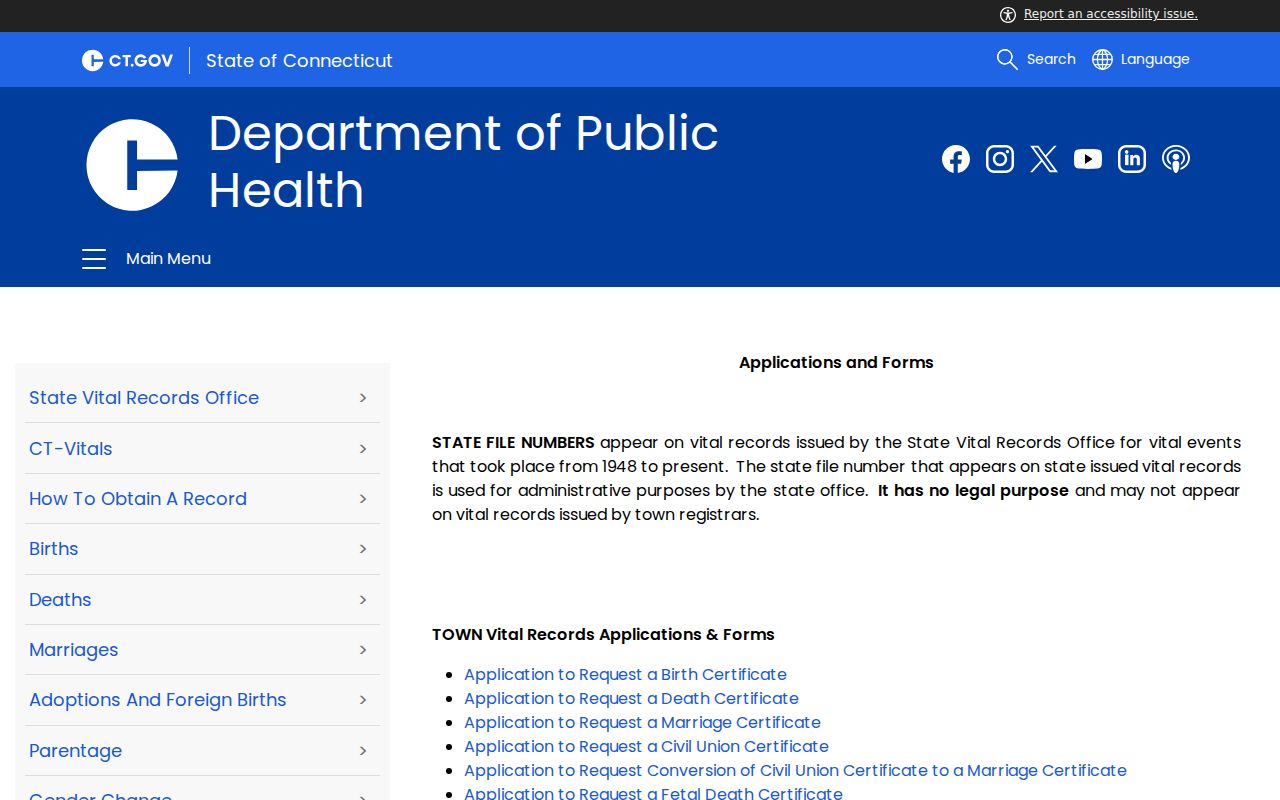
The captured state forms hub shows the application family. Use Manchester's local instructions for its mail, drop-box, ID, and fee details, and use DCF or Probate for adoption and parentage records rather than searching around a protected file.
Manchester's Mill-Village Resident Clues
Manchester's industrial story explains why old address research benefits from more than a deed. Paper, wool, cotton, and silk establishments, the Cheney system, immigration, church life, and railroad connections created neighborhoods and institutions that appear in directories, oral histories, newspapers, cemeteries, yearbooks, and business records. A historical surname may be easier to place when the search includes the village, mill, church, school, or street used at the time.
The Cheney oral-history project includes more than sixty local residents discussing family, education, recreation, the Depression, and the world wars. Those memories can supply a name, institution, or neighborhood lead. They are historical context, not proof of a current address. Compare the clue with a directory page, deed, census household, obituary, cemetery entry, or Probate file.
Manchester Obituary, Cemetery, and Probate Records
The Manchester Newspaper Database is a first stop for an obituary, marriage notice, anniversary, school event, or business change. The municipal Cemetery Division keeps daily-updated records for East, Buckland, Hillstown, and West cemeteries, but no public online name index was located. The State Archives identify Manchester burial permits from 1914-1928 and body-removal permits from 1925-1928 under RG 062:077. Cheney Cemetery Association and Beth Shalom Memorial Park are separate management layers.
Probate PD-13 can connect an estate to heirs and fiduciaries from January 5, 2011 forward. Older Manchester probate may need the historic Hartford route or State Library guidance. A closing record should state whether it is an obituary lead, cemetery record, certificate, deed, or Probate file. That label keeps a past resident from becoming an unsupported current identity claim.
The Manchester Previous-Address Trap
Manchester's addressing instructions normalize the house number, street name, type, direction, and unit for current databases. Historical records may use a different spelling, no ZIP, a village label, an old number, or a legal map reference. Try `Main` and `Main St`, `MIDDLE TPKE W/E`, `E/W CENTER ST`, and the historic locality name, then compare the parcel or map before deciding that two records are different places.
There is no verified official street-renumbering chronology in the research. A failed modern address search therefore calls for a variant search, library help, or Town Clerk assistance. The same caution applies to ZIP labels: keep the municipal town, postal city, ZIP, ZIP+4, situs, mailing address, and legal description apart.
Lawful History for Manchester Previous Residents
Previous residents research is appropriate for family history, a house-history project, genealogy, estate work, reconnecting, and personal civic curiosity. A clear previous residents note names the date and source behind each historical conclusion. A deed can show a title event, a directory can show an occupant clue, and a census can show a household at an earlier enumeration. None should be used to reconstruct a protected address or pursue a living person.
Lawful use. Use past-resident records for a documented historical question. Do not use them to stalk, harass, intimidate, or harm any person, and do not try to defeat Safe at Home or another confidentiality program.
Connecticut's Address Confidentiality Program, voter rules, DMV privacy law, vital-record restrictions, and court confidentiality rules can remove or alter a name or address. When a record seems wrong, contact the originating custodian. Do not republish a substitute or protected address as a correction.