
Find Manchester Residents by Starting Clue
Every clue opens a different door. A name, a street, or a parcel number each leads down its own record path. A historical year does too. Vision is the sensible first stop for owner and assessment account questions. The Connecticut voter lookup confirms a registration match, but it is not a street-wide roster. For deeds, mortgages, releases, liens, and maps, the Town Clerk's RecordHUB index connects the names. Trade names appear there too. A household that predates today's portals belongs on a library shelf, in a newspaper search, or in a census schedule.
Each source answers a different question. An owner name is not a list of occupants. A voter-status result does not prove current residence. A directory entry may name an occupant, a business, or a spouse without proving title. Note the date, record type, and custodian. That small habit keeps a Manchester residents directory search on track. It prevents a pile of same-name guesses.
- Write down the known clue and its date. Preserve street directions, unit wording, maiden names, initials, and old village names such as South Manchester or North Manchester.
- Search Vision by owner, address, account, PID, or MBLU. Save both the situs address and the mailing address because they can point to different places.
- Use the state voter lookup only for an exact name and date-of-birth check. If a match matters, ask the Manchester Registrar of Voters for help rather than treating a non-match as proof of a move.
- Use RecordHUB for the legal trail, then use directories, newspapers, probate, cemetery records, or vital records to test whether an owner was also an occupant.
- When a portal does not reach the needed year or record, ask the holding office, library, History Center, State Library, or Archives for the correct counter, form, copy, or request route.
Manchester Records Offices for Residents
Manchester sits inside Hartford County. Connecticut, though, keeps no county seats and no county recorder for the local deed trail. County government ended October 1, 1960. The Manchester Town Clerk is the practical center for land, map, and trade-name records. Local vital records sit in that office too. Assessment, GIS, elections, courts, and history collections live with other custodians. Name the custodian first, and a Manchester residents directory search starts on solid ground.
Manchester Town Clerk
41 Center Street, Manchester, CT 06040
860-647-3037
Land records, maps, trade names, and local vital records.
Assessor and Vision
Manchester assessment account and parcel records
Use the town department contact route
Owner, address, PID, MBLU, values, features, and sales tools.
Registrar of Voters
479 Main Street, Weiss Center, first floor
860-647-3025
Local voter-file maintenance and status assistance.
A second layer of custodians sits behind the clerk. The Manchester Public Library reference desk, the Manchester History Center, the Greater Manchester Probate Court, and the Judicial Branch each hold their piece. Naming the right office matters more than hunting a generic county one.
Match the Manchester Record to the Question
"Who owns this parcel?" and "Who lived here in 1934?" are different questions that pull different records. A current property question starts with Vision and GIS. A recorded transfer belongs to RecordHUB. A family connection may need a directory, an obituary, a Probate file, or an eligible vital-record copy, and the table keeps those trails separate.
| Question | Best first source | What it can show | Important limit |
|---|---|---|---|
| Who is tied to a parcel? | Vision | Owner, account, situs, mailing address, PID and property traits | Owner is not every occupant |
| Who signed a transfer? | RecordHUB | Grantor, grantee, document, date, book/page, map or legal description | Exact search fields require portal access |
| Is a person registered? | Connecticut voter lookup | Status, party, polling place, and absentee status when returned | Not a public street browse |
| Who lived there before? | Library genealogy desk | Directories, newspapers, oral histories, and local indexes | Historical evidence is not current proof |
Anchor a one-person question twice. Use a full name and a parcel, a name and a court venue, or a name and a dated directory entry. Two anchors beat one, and the result grows stronger when the sources disagree in a way you can explain.
- Roll
- A dated assessment or voter list maintained by a public custodian; it is not automatically a household list.
- Index
- A searchable pointer to a fuller deed, court file, directory page, or other record.
- Criss-cross directory
- An address-first directory that can connect a street or number to a name when a surviving volume uses that format.
- Parcel
- A mapped assessment unit identified by local parcel, account, PID, or MBLU fields.
Manchester Vision Owner and Parcel Records
Vision Government Solutions runs Manchester's public assessment search. The opening screen accepts an address, an owner, an account number, or a PID. It also takes the pieces of an MBLU. A street listing control browses names along a street. A separate sales search filters by date, price, land, building, model, neighborhood, and style. The statewide Vision directory describes the Manchester database as updated daily. Even so, a result is an assessment record, not a live household census.
| Address | Street address, using Manchester spelling and directional forms. |
|---|---|
| Owner | Owner-name search; partial-name behavior is not published on the opening screen. |
| Acct# | Assessment account identifier. |
| PID | Parcel or property identifier. |
| MBLU | Map, map cut, block, block cut, lot, unit, and unit cut components. |
The official Manchester Vision portal puts the choice of search mode on screen before any value is entered. Address, owner, account, MBLU, and PID all appear as options. Those modes carry a typical Manchester residents directory workflow.
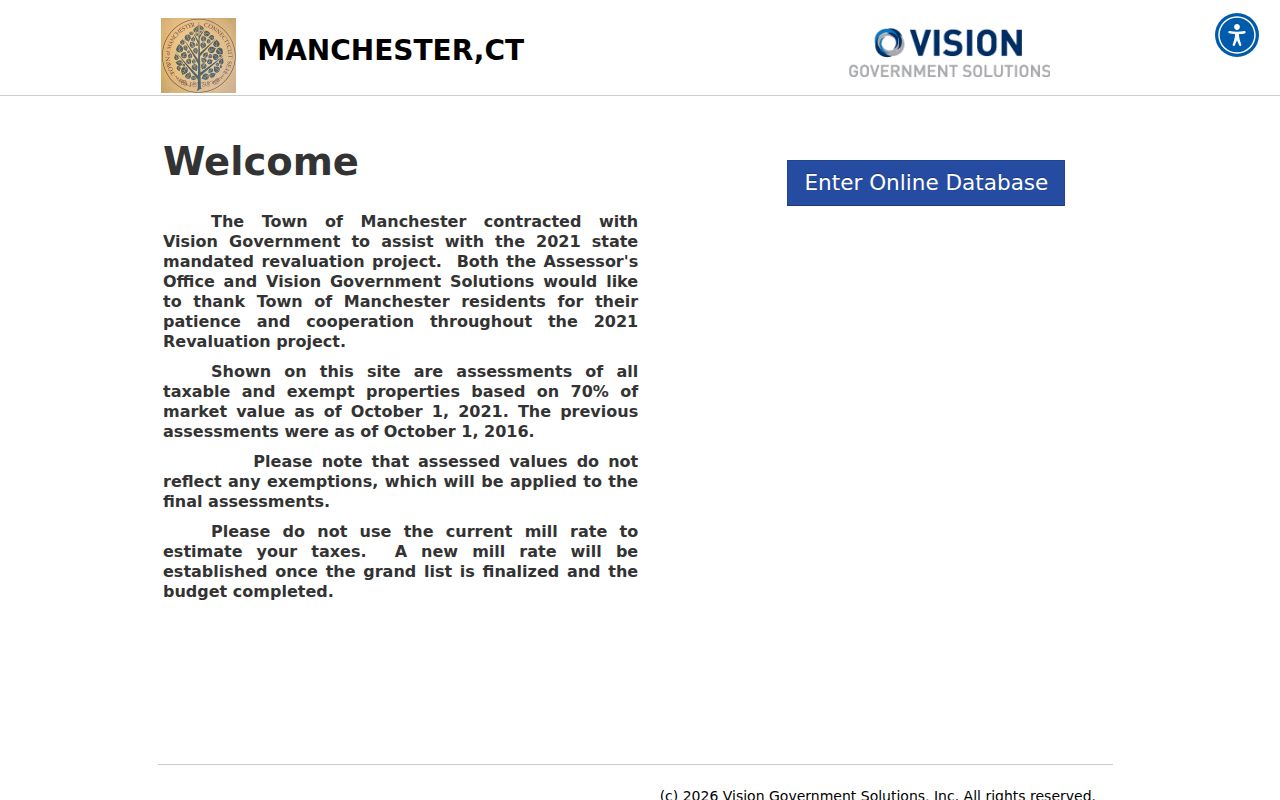
Read a result as an assessment card. It may show owner and mailing context, land and building traits, values, extra features, outbuildings, and valuation history. The 2021 revaluation rests on 70 percent of October 1, 2021 market value. The displayed assessment is not a current tax estimate.
A Map-First Manchester Parcel Check
The Town of Manchester GIS Parcel Viewer adds the spatial step Vision lacks. Search by address, RPKEY, or street name. Click a parcel. Inspect the shapes around it. Layers cover parcels, address points and ranges, roads, buildings, zoning, flood zones, wetlands, historic overlays, easements, private rights of way, utilities, and public boundaries. A property report or map can be built for any selected parcel.
GIS documentation traces the data to deeds, filed plans, and public records, updated as needed. It is not a legal survey. It carries no warranty. Use it to spot a corner parcel, a shared driveway, an address-range mismatch, or a neighbor worth a look. When a boundary carries legal consequences, go to the recorded deed or a surveyor. The map is a bridge. It links a street clue to a parcel identifier, not a roster of everyone present.
Manchester's 1823-to-Today Land Trail
Manchester's Town Clerk keeps land records and maps stretching from the town's 1823 incorporation. Filings made this week sit in the same archive. RecordHUB, the portal behind the search, holds deeds, mortgages, releases, liens, foreclosure registrations, maps, and trade names. A portal account opens the live search. For precise grantor and grantee filtering, rely on the official instructions. A call to the clerk works better than guesswork.
Index and image access through RecordHUB is free under the portal's terms. Printed portal images cost $2 per page. Filed copies run $1 per page plus $2 for certification. Recording a new document carries its own fee schedule. Effective July 1, 2025, the first land-record page is $70. Each additional page of the same document is $5. Special charges apply to certain nominee and map filings. Copy requests by mail, drop box, or in person should include enough book, page, or document detail. That detail lets the clerk locate the record.
| Index field or record | What it contributes | How to use it |
|---|---|---|
| Grantor and grantee | Names of parties in a recorded instrument | Move from the current buyer to an earlier seller |
| Document type and date | Deed, mortgage, release, lien, map, or related filing | Place an event on the property timeline |
| Book/page or document number | Locator for the filed record or copy | Give it to the Town Clerk for a paper or certified route |
| Legal description or map | Lot, map, or metes-and-bounds bridge | Resolve old addresses and street-name changes |
A free PropertyCheck alert is available through the official Town Clerk and RecordHUB route. Enroll there directly if a parcel history matters. Watch for mailed offers that imitate a government notice. Those are a common scam shape.
What Connecticut's Voter Lookup Reveals
Connecticut's state lookup asks for a full first name, last name, and date of birth. It then returns a narrow registration result. Status, party, polling place, and absentee status may appear. An exact spelling or birth date may return nothing. The Manchester Registrar of Voters keeps the local file and can help. A failed match proves nothing about a move, a death, or a registration.
The full Centralized Voter Registration System is a different animal. A complete file request is a $300 CSV order. It requires requester identity and a use certification. Purposes must tie to election, scholarly, journalistic, political, or governmental work. Personal or commercial copying, marketing, sale, reproduction, and harassment are all restricted. Current guidance also limits the birth information ordinarily released. The free lookup answers one status question at a time. It cannot lawfully become a Manchester street roster.
Vital Records at Manchester's 100-Year Line
The Manchester Town Clerk serves as local registrar for town events and qualifying resident births. The Connecticut Department of Public Health State Vital Records Office is the other main route. It handles statewide copies and guidance. Manchester's local coverage starts in 1823. The state office holds birth, marriage, death, and fetal-death records from July 1, 1897 forward. No open current name index exists for these certificates.
Birth and fetal-death records under 100 years are restricted under Conn. Gen. Stat. §7-51. Family members, officials, attorneys, genealogical societies, and approved researchers fall within the listed exceptions. Birth records past 100 years are open. Adult marriage and death copies are generally available. Social Security numbers get special protection under §§7-51 and 7-51a, though. Town and state copy fees differ by record type. A complete request needs the correct form, ID, payment method, and relationship proof where required.
Before ordering, compare the two routes at the Connecticut vital-records hub. That beats assuming a Manchester resident directory can reveal a birth. It also cannot disclose adoption, parentage, or a protected address.
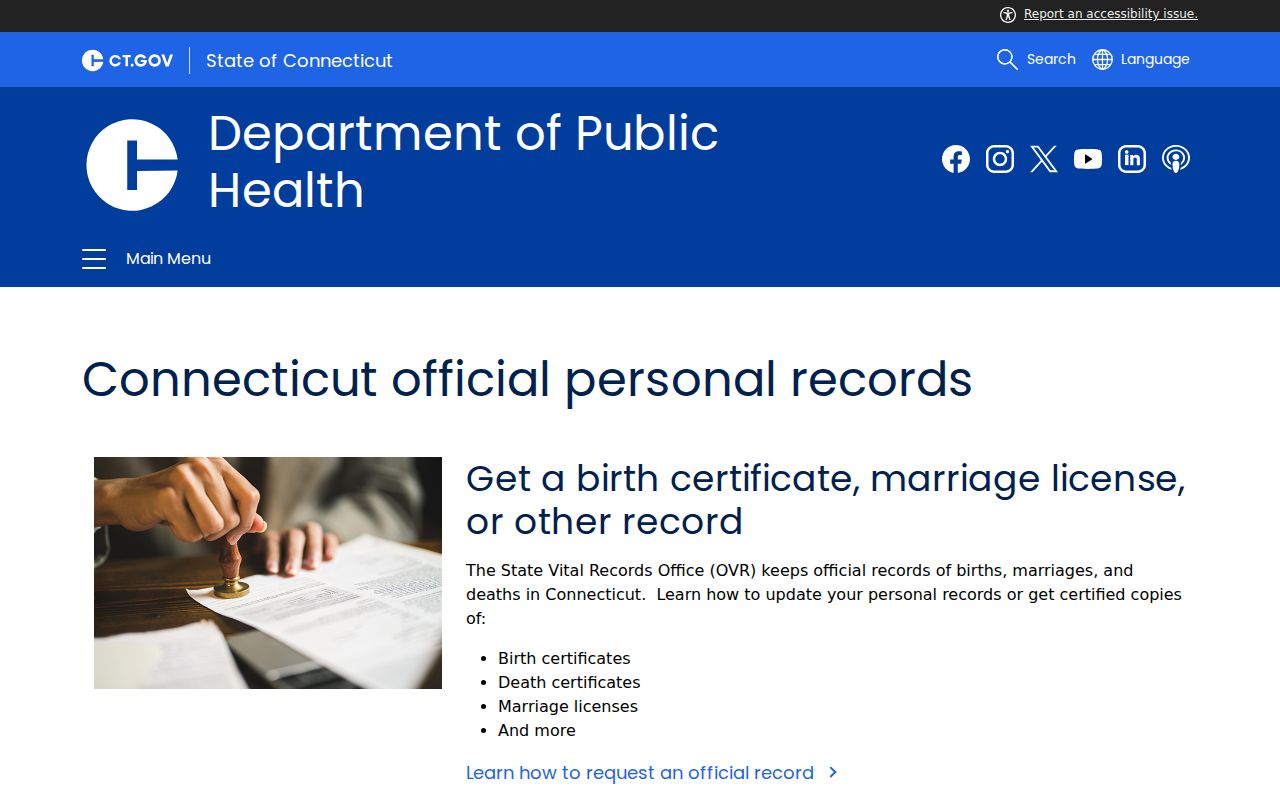
Manchester vital files start at the state's application layer. That layer sets who may order a record and how. Locally, the town covers births from 1823 to the present. Its office explains the ID you need. It also covers the wallet card versus the long-form copy. And it says whether your order travels by mail, drop box, or the approved VitalChek route. Adoption and parentage files sit apart from this process entirely. Those cases run through confidential agency or court channels. They skip a simple name search of the residents directory.
Current Manchester Resident Records
No single current roll names every Manchester resident. Directory-style sources here are record-specific, and each one carries its own access rule. The comparison table helps you pick a source without claiming more than it proves. Whether your starting clue is a parcel, a name, or a dated household, this is the working map for any Manchester residents directory question.
| Source | People or places represented | Custodian | Access |
|---|---|---|---|
| Assessment record | Owner/account and parcel context | Manchester Assessor and Vision | Free public portal |
| Land-record index | Deed, lien, mortgage, map, and trade-name parties | Manchester Town Clerk | RecordHUB, books, copies |
| Voter status | Registration match and polling information | Registrar and Secretary of the State | Exact-name lookup, restricted full file |
| Permit history | Address-linked work and project records | Building Inspection Division | CSS public search |
| Historical collections | Past occupants, families, businesses, and civic life | Library, History Center, State Library | Reference, scans, archives |
Assessor rolls and the land index handle present-day property questions. The historical shelf handles past-household ones. For a name-first search, the Manchester resident lookup page traces one person's verification path from start to finish.
The Manchester Directory Shelf Since 1891
City directories for Manchester reach back to 1891, according to the public library's genealogy page. Many volumes sit in the reference case there. The Manchester History Center adds vintage business directories, maps, yearbooks, local books, and genealogy material. Historical Society reprints cover 1917, 1922, 1927, 1934, and 1946. Later holdings include 1943 and 1953-54. One volume, the 1934 Price & Lee, is digitized online.
Each publisher arranged its book differently. An entry might list an address, occupation, spouse notation, business tie, or a status shorthand. But sections vary by year and publisher. A historical entry proves nothing about who lives somewhere now. Before trusting a missing name, ask staff about the volume's format. It may be alphabetical, business, telephone, or reverse-indexed by address. The Manchester city directory collections page tells the full collection story year by year.
Confirm a Name Through Manchester Courts
Connecticut's Superior Court party search works from a required last name and builds outward. You can add a first name, location, case category, case type, sort order, and a name-search mode such as starts with, contains, equal to, or sounds like. Where a case lands depends on its type. Manchester criminal and motor-vehicle matters go to Geographical Area 12 at 410 Center Street. Civil and family matters run through the Hartford Judicial District system. Treat any web result as a convenience rather than the official file, since protected, sealed, erased, juvenile, and confidential matters may simply never appear.
Probate lives on its own track. The Greater Manchester Probate District PD-13 lookup takes case type, district, status, last name, and first name, and it returns case number, name, type, and district for coverage starting January 5, 2011. Older Manchester probate may sit under the historic Hartford district instead. Remember what a row really is. It is a lead toward the clerk's file, not a complete estate record or a guaranteed current address.
When Manchester Portals Stop Short
Screens only carry you so far. A paper land book can settle an unreadable image. The clerk can explain a copy route. The library can pinpoint a directory year that was never digitized. The History Center can point you toward a map, yearbook, or local book, while the State Library and Archives handle census, probate, court-index, burial-permit, and town-document guidance. When an office holds a releasable record but no portal exposes it, a targeted Connecticut Freedom of Information Act request can reach it.
The Connecticut FOI guidance asks that each request name the record, the date range, the people or addresses involved, and your preferred inspection or copy format. FOI has limits. It does not override birth, adoption, voter, DMV, sealed-court, juvenile, or Safe-at-Home restrictions. Inspection is often cheaper than a certified copy, and any denial or unreasonable delay can be appealed to the FOI Commission.
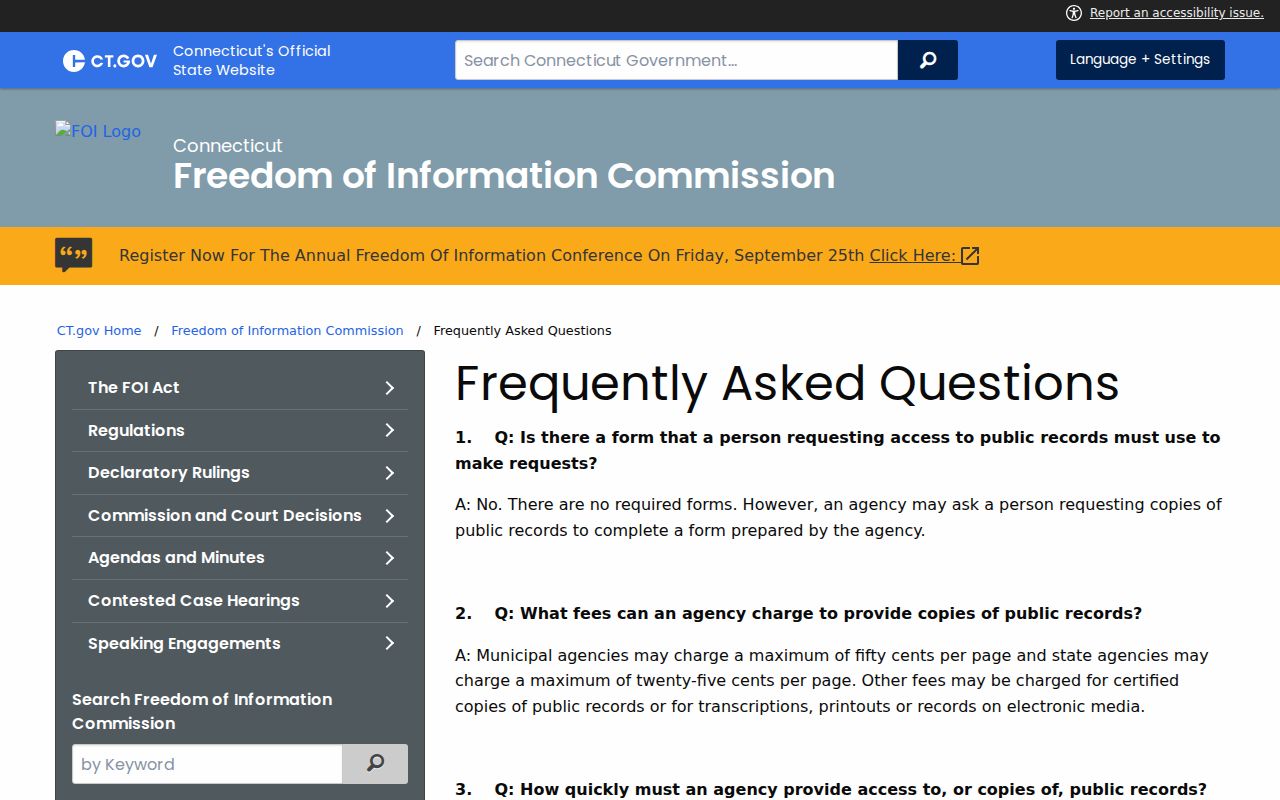
The FOI page is a fallback map. It does not promise that a broad request will yield a resident list. Aim a narrow request at a named custodian, such as the Town Clerk, Assessor, Building Inspection Division, Registrar, Police Records, or Collector.
Privacy Boundaries Around Manchester Records
Public never means unlimited. Connecticut's Safe at Home program can give an eligible participant a substitute mailing address. The Driver's Privacy Protection Act governs DMV personal information. Voter data carries its own release and use rules. Birth, adoption, parentage, and certain court material each face separate restrictions. One more caution belongs here. A visible mailing address can belong to a trust, bank, attorney, or out-of-town owner. Occupants and utility customers stay outside ordinary property records entirely.
Lawful personal use. Manchester records are useful for family history, civic research, reconnecting, and house history. Do not use a record to stalk, harass, intimidate, or harm another person.
| Official record | Starts with a named custodian and a stated record type. |
|---|---|
| Commercial compilation | May merge names, retain stale addresses, omit protected people, or attach a fee to an uncertain inference. |
| Best correction path | Ask the originating Town Clerk, Assessor, Registrar, court, DPH, SOTS, or licensing office to review its own record. |
Specialized State Searches Need Context
Connecticut also publishes specialized searches covering professional licenses, business entities, and unclaimed property. The set also includes DOC custody and the sex-offender registry. Each one fits a narrow question. That may be a credential, an estate lead, or a state custody record. None of them is a general Manchester residents directory. A name hit still demands the source's own date, status, and identity checks. Only then does it mean much.
The Connecticut sex-offender registry information page lays out the official route and its statutory context. Do not stretch it into a broad address search. It is not a full account of anyone's history either. The same restraint applies to the DOC locator and to business or licensing records.
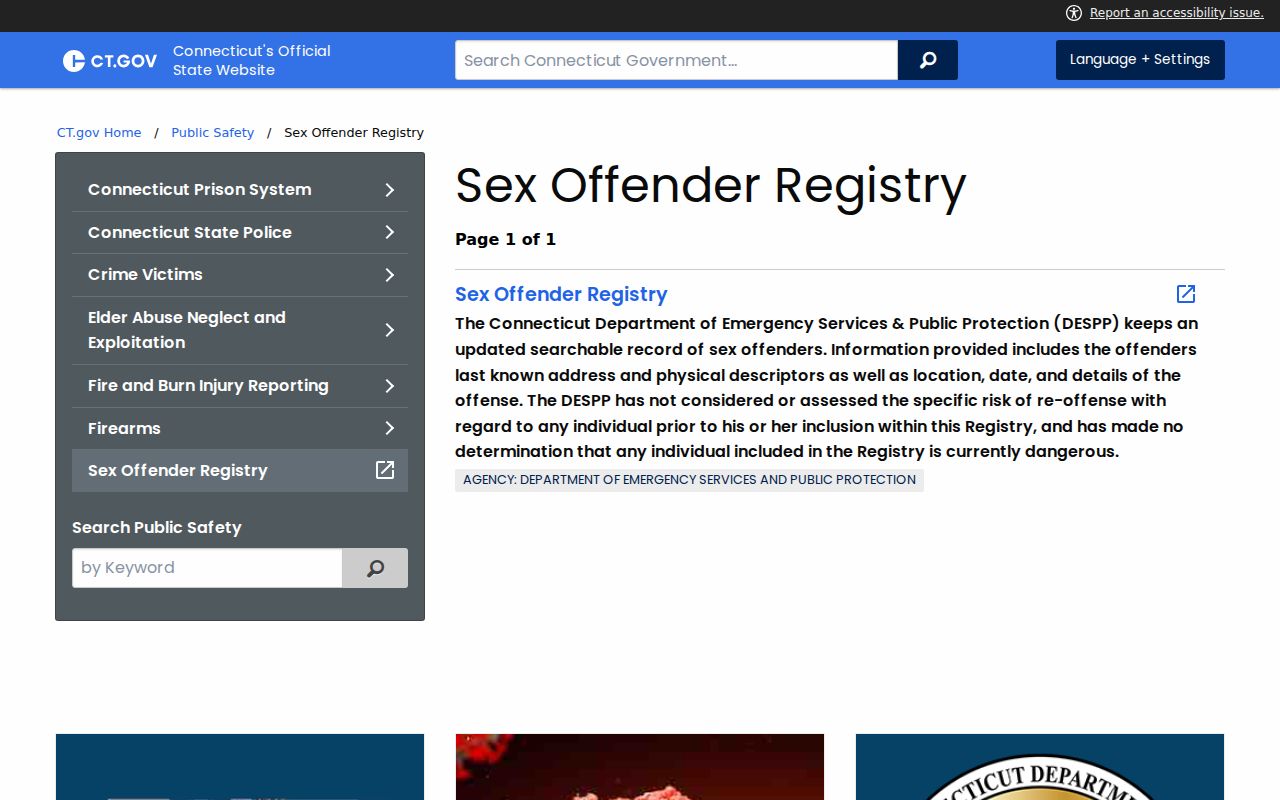
The registry screenshot serves as source context only. A specialized public record answers the narrow question its statute sets. It cannot fill gaps left by the assessor, Town Clerk, library, or protected programs.
Manchester's Record-Keeping Story
Manchester split from East Hartford and became a town in May 1823. Industry followed fast. Paper, wool, cotton, and silk production took hold. The Cheney mills grew into an institution. Railroad service arrived in 1850. Those changes generated the land transfers, mill-village addresses, directories, church records, cemeteries, newspapers, and family papers. Together they support a historical residents search today.
The library's own story threads through that record trail. A Cheney worker reading room existed by 1840. A free public library formed in 1871. A 1913 fire destroyed the South Manchester library quarters. That event is library history, though, not proof that the Town Clerk's land books or Manchester vital records were lost. For current work, note that RecordHUB, Vision, GIS, permit search, fees, and privacy rules all change. They change on different schedules.
Recent Changes to Manchester Records
Several recent developments make dates worth keeping. Manchester's 2026 revaluation notice and the July 2025 land-record fee changes touch what a parcel search costs and shows. PropertyCheck promotion and Town Clerk Week programming shift the portal landscape too. The state also reported a January 2026 dispute over a requested voter file. A February 2026 report covered data-broker concerns as well. None of this alters the historic records themselves. But fees, forms, portal fields, and the line between an official search and bulk republication all move.
So reopen the custodian's page before paying, traveling, or leaning on a result. Confirm the live fee, hours, form, access level, and any warning about delays or protected information. That final check belongs in any trustworthy Manchester residents directory workflow.